About Platform
Shvasa is a leading wellness platform, transforming yoga wisdom into a globally scalable solution for modern lifestyles, helping users build lasting habits with flexible, round-the-clock classes tailored to their needs.

Revised Smarter Booking
Our Commitment to Health & Well-Being
Shvasa’s is commitment to promoting health and well-being through holistic fitness programs in USA & Canada

Revised Smarter Booking
Our Commitment to Health & Well-Being
Shvasa’s is commitment to promoting health and well-being through holistic fitness programs in USA & Canada
About Platform
Shvasa is a wellness platform, transforming yoga wisdom into a globally scalable solution for modern lifestyles, helping users build lasting habits with flexible, round-the-clock classes tailored to their needs.
Project Date
Nov 2025 -
March 2026
My Role
Qualitative & Quantative Research
Conceptualization
Design
Dev handoff
Quality Assurance
Project Type
Product Design
UI Design
Revised Smarter Booking
Our Commitment to Health & Well-Being
Shvasa’s is commitment to promoting health and well-being through holistic fitness programs in USA & Canada
About Platform
Shvasa is a leading wellness platform, transforming yoga wisdom into a globally scalable solution for modern lifestyles, helping users build lasting habits with flexible, round-the-clock classes tailored to their needs.
PRoject date
2 Months
September 2024 - November 2024
My Role
Qualitative & Quantative Research
Conceptualization
Design
Dev handoff
Quality Assurance
Project TYPE
Product Design
UI Design
Every class booking drives revenue and retention
5.6/10 users dropped off before booking a class, making it a key conversion opportunity. We identified friction across discovery, decision-making, and booking.
So we redesigned the flow from static to smart, adapting actions based on user intent and surfacing the right information at the right moment to reduce friction.
The result? 48% higher booking rate and 37% fewer drop-offs.

Every class booking drives revenue and retention
5.6/10 users dropped off before booking a class, making it a key conversion opportunity. We identified friction across discovery, decision-making, and booking. So we redesigned the flow from static to smart, adapting actions based on user intent and surfacing the right information at the right moment to reduce friction.
The result? 48% higher booking rate and 37% fewer drop-offs.

Every class Booking Drives Revenue and
Retention
5.6/10 users dropped off before booking a class, making it a key conversion opportunity. We identified friction across discovery, decision-making, and booking.
So we redesigned the flow from static to smart, adapting actions based on user intent and surfacing the right information at the right moment to reduce friction.
The result? 48% higher booking rate and 37% fewer drop-offs.

Let’s Look at the flow first :) It’s on loop, you might have to wait a few seconds
Do you have any medical conditions?
For your safety, our teachers will tailor sessions with your medical needs in mind
None
Shoulder & Neck Pain
Knee Issues
Arthritis
Hypertension
Diabetes
PCOS
Thyroid
Back Pain
Anxiety & depression
Other
Next
9:41
Back
YOGA IN EVERY BREATH
The brief that started it all
This project focused on redesigning the class booking experience, from class discovery and selection to booking. The goal was to increase bookings, improve attendance and engagement, and create a more intuitive, rewarding, and user-centered experience.
Project Brief
The booking experience was functional but restrictive. Users had limited information to evaluate their options and few ways to explore or compare classes before making a decision, leaving an opportunity to make class discovery and decision-making more seamless and informed.
Approach
We followed a data-informed, iterative design approach - starting by analyzing user engagement and booking behavior, identifying friction points, exploring solutions, and rapidly prototyping the new flow. We validated our direction through usability testing and A/B testing, using real user behavior to refine the experience. Each iteration helped simplify decision-making and create a smoother path from discovery to booking.
The brief that started it all
This project focused on redesigning the class booking experience, from class discovery and selection to booking. The goal was to increase bookings, improve attendance and engagement, and create a more intuitive, rewarding, and user-centered experience.
Project
Brief
The booking experience was functional but restrictive. Users had limited information to evaluate their options and few ways to explore or compare classes before making a decision, leaving an opportunity to make class discovery and decision-making more seamless and informed.
Approach
We followed a data-informed, iterative design approach - starting by analyzing user engagement and booking behavior, identifying friction points, exploring solutions, and rapidly prototyping the new flow. We validated our direction through usability testing and A/B testing, using real user behavior to refine the experience. Each iteration helped simplify decision-making and create a smoother path from discovery to booking.
The brief that started it all
This project focused on redesigning the class booking experience, from class discovery and selection to booking. The goal was to increase bookings, improve attendance and engagement, and create a more intuitive, rewarding, and user-centered experience.
Project Brief
The booking experience was functional but restrictive. Users had limited information to evaluate their options and few ways to explore or compare classes before making a decision, leaving an opportunity to make class discovery and decision-making more seamless and informed.
Approach
We followed a data-informed, iterative design approach - starting by analyzing user engagement and booking behavior, identifying friction points, exploring solutions, and rapidly prototyping the new flow. We validated our direction through usability testing and A/B testing, using real user behavior to refine the experience. Each iteration helped simplify decision-making and create a smoother path from discovery to booking.
Problem Statement
Completing a task
value for money
personalization
make confident choices
Booking a class felt more like a task than an opportunity to communicate its value. Users had limited context to understand what they would gain from each class or why they should explore and book more. We needed to make the experience more valuable, informative, and relevant to each user by clearly communicating the value of each class, helping users make confident choices and discover more value throughout their practice.
Trial → Booking → Attendance
10
FT users start a free trial
4-5
Book a class
2
attend the class they booked
A significant gap existed between signing up, booking, and actually attending a class — highlighting an opportunity to improve the booking experience.
A closer look at how trial and paid user move through the booking flow
44%
average FT booking rate in
the first 2 weeks
56%
of free trial users didn’t book
a single class
33-47%
FT show-up rate among
users who did book
55%
of paid users didn’t book a
class either
Problem Statement
Completing a task
value for money
personalization
make confident choices
Booking a class felt more like a task than an opportunity to communicate its value. Users had limited context to understand what they would gain from each class or why they should explore and book more. We needed to make the experience more valuable, informative, and relevant to each user by clearly communicating the value of each class, helping users make confident choices and discover more value throughout their practice.
A closer look at how trial and paid user move through the booking flow
44%
average FT booking rate in
the first 2 weeks
56%
of free trial users didn’t book
a single class
33-47%
FT show-up rate among
users who did book
55%
of paid users didn’t book a
class either
Trial → Booking → Attendance
10
FT users start a free trial
4-5
Book a class
2
attend the class they booked
A significant gap existed between signing up, booking, and actually attending a class — highlighting an opportunity to improve the booking experience.
4-5
Problem Statement
Completing a task
value for money
personalization
make confident choices
Booking a class felt more like a task than an opportunity to communicate its value. Users had limited context to understand what they would gain from each class or why they should explore and book more. We needed to make the experience more valuable, informative, and relevant to each user by clearly communicating the value of each class, helping users make confident choices and discover more value throughout their practice.
A closer look at how trial and paid user move
through the booking flow
56%
of free trial users didn’t book
a single class
44%
average FT booking rate in
the first 2 weeks
33-47%
FT show-up rate among
users who did book
55%
of paid users didn’t book a
class either
Trial → Booking → Attendance
10
FT users
start a free trial
4-5
Book
a class
2
attend the class
they booked
A significant gap existed between signing up, booking, and actually attending a class — highlighting an opportunity to improve the booking experience.
Key takeaways from research
We combined deep user interviews with a layered analysis of industry best practices and competitor approaches.

From primary research
Users found booking more task-oriented than value-driven, with limited context around why a class was relevant to them.
Users experienced friction when selecting and booking classes, particularly when faced with multiple steps and decisions.
Users are more likely to continue engaging when they can see their progress and receive meaningful feedback throughout their journey.
From secondary research & competitor analysis
Simple and streamlined booking flows reduce friction and help users move quickly from discovery to action.
Personalized recommendations and clear class information help users understand which class is relevant to their goals, making decision-making easier.
Progress, plans, and post-class experiences can give users a stronger sense of value and encourage continued engagement beyond individual class bookings.


“
“
I don’t always know which
class is right for me. I need
more context before I can decide.
— P2, Female, 27, Bengaluru
Users need more information about the class & its benefits to make confident booking decisions..

“
“
Booking a class feels more like a task than something that adds value to my practice.
— P6, Female, 31, Bengaluru
The booking experience feels transactional and lacks the sense of connection to the users’ wellness journey.

“
“
Too many steps and options make the booking process confusing and time-consuming.
— P6, Female 29, Mumbai
Conplex flows and multiple decisions create
friction, leading to drop-offs before booking.

“
“
I’m more likely to show up and stay consistent when I can track my progress and feel supported.
— P5, Female, 30, Delhi
Users value progress tracking, feedback and personalized experience to stay engaged and motivated.
Key takeaways from research
We combined deep user interviews with a layered analysis of industry best practices and competitor approaches.
From primary research
Users found booking more task-oriented than value-driven, with limited context around why a class was relevant to them.
Users experienced friction when selecting and booking classes, particularly when faced with multiple steps and decisions.
Users are more likely to continue engaging when they can see their progress and receive meaningful feedback throughout their journey.
From secondary research & competitor analysis
Simple and streamlined booking flows reduce friction and help users move quickly from discovery to action.
Personalized recommendations and clear class information help users understand which class is relevant to their goals, making decision-making easier.
Progress, plans, and post-class experiences can give users a stronger sense of value and encourage continued engagement beyond individual class bookings.

“
“
“
“
I don’t always know which class is right for me. I need more
context before I can decide.
— P2, Female, 27, Bengaluru
Users need more information about the class & its benefits to make confident booking decisions.
“
Booking a class feels more like a task than something that adds value to my practice.
— P6, Female, 31, Bengaluru
The booking experience feels transactional and lacks the sense of connection to the users’ wellness journey.
“
Too many steps and options make the booking process confusing and time-consuming.
— P6, Female, 29, Mumbai
Complex flows and multiple decisions create friction, leading to drop-offs before booking.
“
“
I’m more likely to show up and stay consistent when I can track my progress and feel supported.
— P5, Female, 30, Delhi
Users value progress tracking, feedback, and personalized experiences to stay engaged and motivated
Key takeaways from research
We combined deep user interviews with a layered analysis of industry best practices and competitor approaches.

From secondary research & competitor analysis
Simple and streamlined booking flows reduce friction and help users move quickly from discovery to action.
Personalized recommendations and clear class information help users understand which class is relevant to their goals, making decision-making easier.
Progress, plans, and post-class experiences can give users a stronger sense of value and encourage continued engagement beyond individual class bookings.

From primary research
Users found booking more task-oriented than value-driven, with limited context around why a class was relevant to them.
Users experienced friction when selecting and booking classes, particularly when faced with multiple steps and decisions.
Users are more likely to continue engaging when they can see their progress and receive meaningful feedback throughout their journey.
“
I don’t always know which class is right for me. I need more context before I can decide.
— P2, Female, 27, Bengaluru
Users need more information about the class & its benefits to make confident booking decisions.
“
Booking a class feels more like a task than something that adds value to my practice.
— P6, Female, 31, Bengaluru
The booking experience feels transactional and lacks the sense of connection to the users’ wellness journey.
“
Too many steps and options make the booking process confusing and time-consuming.
— P6, Female, 29, Mumbai
Complex flows and multiple decisions create friction, leading to drop-offs before booking.
“
I’m more likely to show up and stay consistent when I can track my progress and feel supported.
— P5, Female, 30, Delhi
Users value progress tracking, feedback, and personalized experiences to stay engaged and motivated
The many faces of a shvasa user
User Cohorts (Behavioral Segments)
Users engage with class booking in very different ways — some book on a fixed weekly rhythm, others only when the mood or moment allows, and a few show up reactively, driven by circumstance rather than routine. Mapping these cohorts helped shape solutions that meet a range of lifestyles and constraints, not just booking intent.

Books last-minute, prefers flexible/reschedulable slots across time zones. Likely to drop off if the platform doesn't clearly show class times adjusted to their current location. Low loyalty to a single instructor — books whoever's live when they're free.
Frequent traveler

Shift worker
Irregular booking pattern tied to
shift rotation — no fixed “usual time.” Needs classes at unconventional hours (late night, early morning) and struggles with a rigid weekly schedule UI. High cohort overlap with the “Silent Browser” if the platform only surfaces daytime slots.

Books in narrow, predictable windows
(nap time, early morning, after bedtime). High cancellation/reschedule rate due to child-related interruptions. Values short class durations and forgiving cancellation policies.
Parent with young kids

Books around group sessions, challenges, or when friends/instructors they follow are live. Motivated by social presence — likely to book instantly if a “buddy” or community member is also attending.
Community-driven user

Weather-constrained user
Booking spikes indoors during bad weather (rain, extreme heat/cold) and dips when outdoor activity is possible. Likely to book same-day rather than in advance, reacting to conditions rather than planning ahead.

Books in advance but around a tight calendar — often squeezes sessions between meetings. Prefers quick-glance scheduling (calendar sync) and shorter formats (20–30 min) over exploring options. Drop-off risk is high if booking takes more than a couple of taps.
Busy professional

Books cautiously, often needing simpler navigation and larger touch targets. Prefers gentle/restorative class categories and may need more assurance (clear instructor credentials, easy support access) before committing. Lower tolerance for complex or multi-step booking flows.
Senior citizen

Books consistently from a fixed home setup — likely a creature-of-habit booker with a preferred time slot and instructor. Low friction tolerance for anything that disrupts their routine (app lag, video
quality issues).
Home workout user
Books last-minute, prefers flexible/reschedulable slots across time zones. Likely to drop off if the platform doesn't clearly show class times adjusted to their current location. Low loyalty to a single instructor — books whoever's live when they're free.
Frequent traveler
Shift worker
Irregular booking pattern tied to
shift rotation — no fixed “usual time.” Needs classes at unconventional hours (late night, early morning) and struggles with a rigid weekly schedule UI. High cohort overlap with the “Silent Browser” if the platform only surfaces daytime slots.
Books in narrow, predictable windows
(nap time, early morning, after bedtime). High cancellation/reschedule rate due to child-related interruptions. Values short class durations and forgiving cancellation policies.
Parent with young kids
Books around group sessions, challenges, or when friends/instructors they follow are live. Motivated by social presence — likely to book instantly if a “buddy” or community member is also attending.
Community-driven user
Weather-constrained user
Booking spikes indoors during bad weather (rain, extreme heat/cold) and dips when outdoor activity is possible. Likely to book same-day rather than in advance, reacting to conditions rather than planning ahead.

Books in advance but around a tight calendar — often squeezes sessions between meetings. Prefers quick-glance scheduling (calendar sync) and shorter formats (20–30 min) over exploring options. Drop-off risk is high if booking takes more than a couple of taps.
Busy professional
Books cautiously, often needing simpler navigation and larger touch targets. Prefers gentle/restorative class categories and may need more assurance (clear instructor credentials, easy support access) before committing. Lower tolerance for complex or multi-step booking flows.
Senior citizen
Books consistently from a fixed home setup — likely a creature-of-habit booker with a preferred time slot and instructor. Low friction tolerance for anything that disrupts their routine (app lag, video
quality issues).
Home workout user
The many faces of a shvasa user
User Cohorts (Behavioral Segments)
Users engage with class booking in very different ways — some book on a fixed weekly rhythm, others only when the mood or moment allows, and a few show up reactively, driven by circumstance rather than routine. Mapping these cohorts helped shape solutions that meet a range of lifestyles and constraints, not just booking intent.
The many faces of a Shvasa user
User Cohorts (Behavioral Segments)
Users engage with class booking in very different ways — some book on a fixed weekly rhythm, others only when the mood or moment allows, and a few show up reactively, driven by circumstance rather than routine. Mapping these cohorts helped shape solutions that meet a range of lifestyles and constraints, not just booking intent.
Books last-minute, prefers flexible/reschedulable slots across time zones. Likely to drop off if the platform doesn't clearly show class times adjusted to their current location. Low loyalty to a single instructor — books whoever's live when they're free.
Frequent traveler
Shift worker
Irregular booking pattern tied to
shift rotation — no fixed “usual time.” Needs classes at unconventional hours (late night, early morning) and struggles with a rigid weekly schedule UI. High cohort overlap with the “Silent Browser” if the platform only surfaces daytime slots.
Parent with young kids
Books in narrow, predictable windows
(nap time, early morning, after bedtime). High cancellation/reschedule rate due to child-related interruptions. Values short class durations and forgiving cancellation policies.
Community-driven user
Books around group sessions, challenges, or when friends/instructors they follow are live. Motivated by social presence — likely to book instantly if a “buddy” or community member is also attending.
Weather-constrained user
Booking spikes indoors during bad weather (rain, extreme heat/cold) and dips when outdoor activity is possible. Likely to book same-day rather than in advance, reacting to conditions rather than planning ahead.

Busy professional
Books in advance but around a tight calendar — often squeezes sessions between meetings. Prefers quick-glance scheduling (calendar sync) and shorter formats (20–30 min) over exploring options. Drop-off risk is high if booking takes more than a couple of taps.

Senior citizen
Books cautiously, often needing simpler navigation and larger touch targets. Prefers gentle/restorative class categories and may need more assurance (clear instructor credentials, easy support access) before committing. Lower tolerance for complex or multi-step booking flows.

Home workout user
Books consistently from a fixed home setup — likely a creature-of-habit booker with a preferred time slot and instructor. Low friction tolerance for anything that disrupts their routine (app lag, video
quality issues).
Contributing factors
Immediate
Result
No
Schedule
Low
Motivation
Contributing factors
Immediate
Result
No
Schedule
Low
Motivation
Contributing factors
Immediate
Result
No
Schedule
Low
Motivation
Early Concepts And Testing
We conducted two tests between June - August 2024 with limited tech implementation, followed by two more from February to May 2025 that introduced reduced steps in the class booking funnel. These experiments aimed to measure performance, validate customer interest, and assess impact on key metrics like Cost per Lead (CPL), ultimately helping us determine the value of investing in a full-fledged, end-to-end booking experience.
The results? Out of an average of 3354 clicks
users who interacted with the Weekly class Recommendation spent 45% less time in the flow, compared to the previous version.
Users who Repeat Last Teacher’s Class suggestion had 2.4x higher retention, suggesting minimal effort boosts consistency.
35% of total bookings came from the “Recommended for You” section, showing the impact of personalized suggestions.
Test 2: Introducing Weekly Schedule
Component
June 2024 - August 2024
We started small with two experiments:
Recommended Weekly Schedule: A component
appears when you book a class it gives you
suggestion for whole week.
Targeted Class Suggestions: It directly displays
available classes tailored to focus on different
parts of the body.
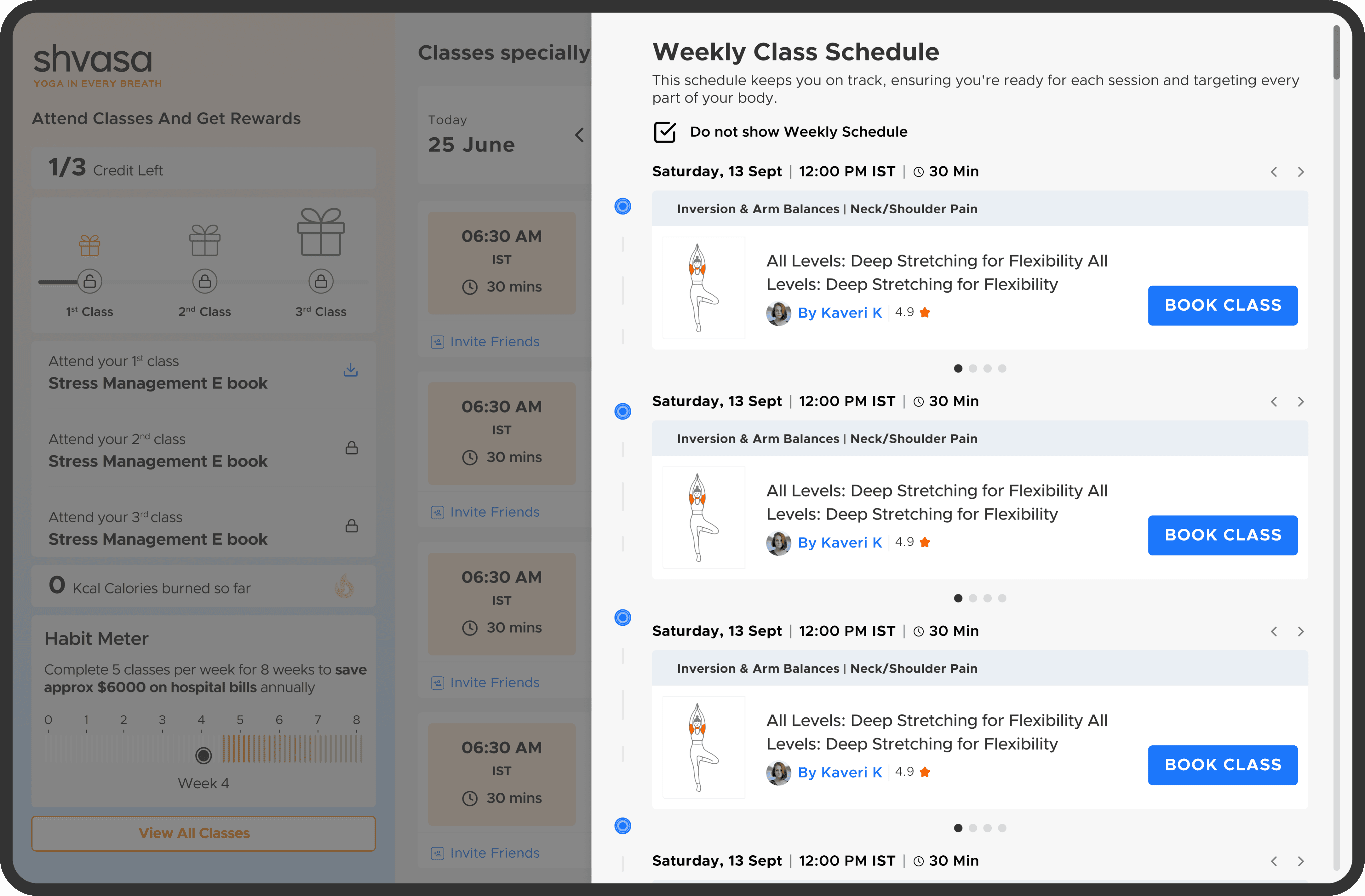
The results from the second test?
Users spent 2.7x more time in the app weekly
compared to non-plan users, highlighting higher engagement levels.
Only 11% of users returned to the plan page after initial setup, indicating low stickiness.
Users who missed 3+ sessions had a 70% lower chance of completing the plan.
Test 1: Introducing 28 day challenge
April 2024 - June 2024

The goal was to make a habit for users to be
consistent on exercise.
Added a dedicated 28 Day Plan page, accessible
via a “28 day plan” CTA while onboarding & in
Progress Card.
Introduced reward after every week which
motivates them again to Join class.
Early Concepts And Testing
We conducted two tests between June - August 2024 with limited tech implementation, followed by two more from February to May 2025 that introduced reduced steps in the class booking funnel. These experiments aimed to measure performance, validate customer interest, and assess impact on key metrics like Cost per Lead (CPL), ultimately helping us determine the value of investing in a full-fledged, end-to-end booking experience.
The results from the second test?
Users spent 2.7x more time in the app weekly compared to non-plan users, highlighting higher engagement levels.
Only 11% of users returned to the plan page after initial setup, indicating low stickiness.
Users who missed 3+ sessions had a 70% lower chance of completing the plan.
Test 1: Introducing 28 day challenge
April 2024 - June 2024
The goal was to make a habit for users to be consistent on exercise.
Added a dedicated 28 Day Plan page, accessible via a “28 day plan” CTA while onboarding & in Progress Card.
Introduced reward after every week which
motivates them again to Join class.
The results? Out of an average of 3354 clicks
users who interacted with the Weekly class Recommendation spent 45% less
time in the flow, compared to the previous version.
Users who Repeat Last Teacher’s Class suggestion had 2.4x higher retention, suggesting minimal effort boosts consistency.
35% of total bookings came from the “Recommended for You” section, showing the impact of personalized suggestions.
Test 2: Introducing Weekly Schedule
Component
June 2024 - August 2024
We started small with two experiments:
Recommended Weekly Schedule: A component appears when you book a class it gives you suggestion for whole week.
Targeted Class Suggestions: It directly displays available classes tailored to focus on different parts of the body.
Early concepts and testing
We conducted two tests between June - August 2024 with limited tech implementation, followed by two more from February to May 2025 that introduced reduced steps in the class booking funnel. These experiments aimed to measure performance, validate customer interest, and assess impact on key metrics like Cost per Lead (CPL), ultimately helping us determine the value of investing in a full-fledged, end-to-end booking experience.
Test 1: Introducing 28 day challenge
April 2024 - June 2024
The goal was to make a habit for users to be consistent on exercise.
Added a dedicated 28 Day Plan page, accessible via a “28 day plan” CTA while onboarding & in Progress Card.
Introduced reward after every week which
motivates them again to Join class.
The results from the second test?
Users spent 2.7x more time in the app weekly compared to non-plan users, highlighting higher engagement levels.
Only 11% of users returned to the plan page after initial setup, indicating low stickiness.
Users who missed 3+ sessions had a 70% lower chance of completing the plan.
Test 2: Introducing Weekly Schedule
Component
June 2024 - August 2024
Recommended Weekly Schedule: A component appears when you book a class it gives you suggestion for whole week.
Targeted Class Suggestions: It directly displays available classes tailored to focus on different parts of the body.
The results? Out of an average of 3354 clicks
users who interacted with the Weekly class Recommendation spent 45% less time in the flow, compared to the previous version.
Users who Repeat Last Teacher’s Class suggestion had 2.4x higher retention, suggesting minimal effort boosts consistency.
35% of total bookings came from the “Recommended for You” section, showing the impact of personalized suggestions.
Onboarding flow
Scroll



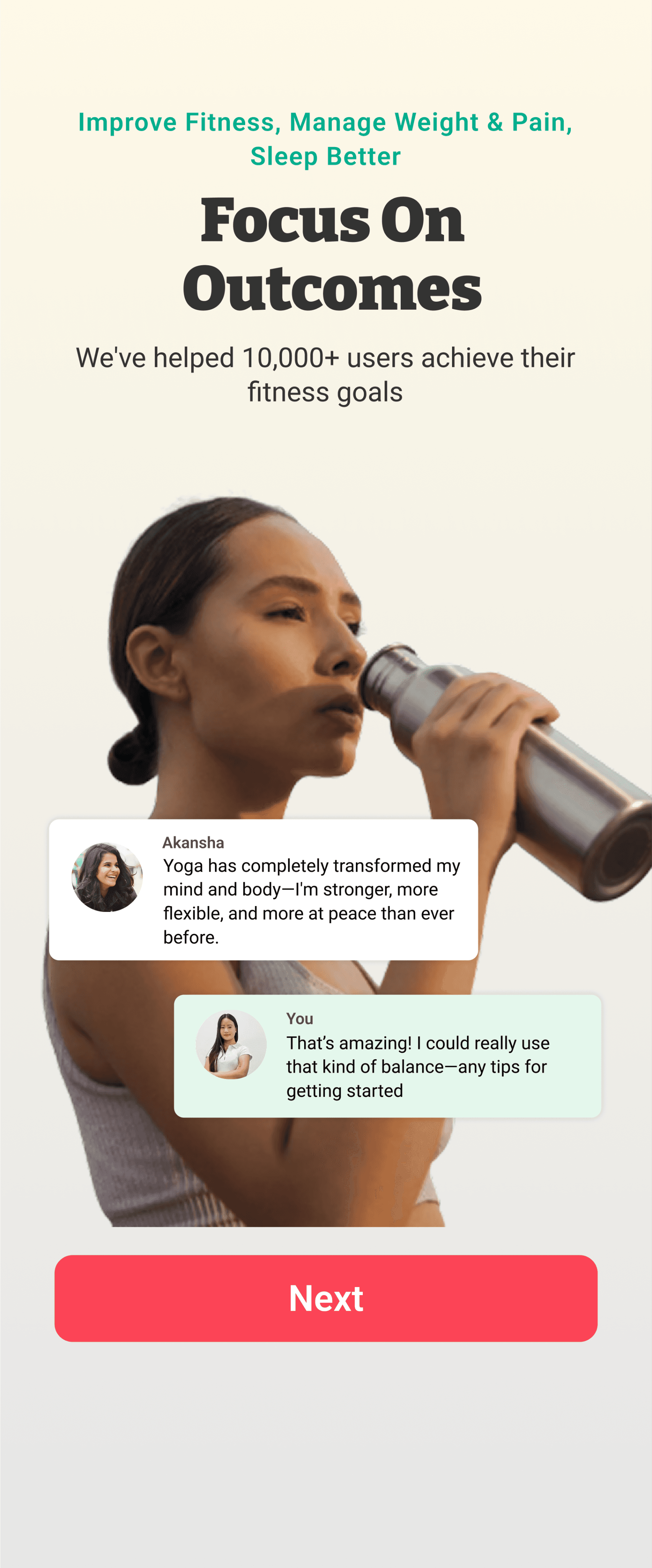





BOOK cLASS


Attending class
Scroll


Onboarding flow
Scroll


BOOK cLASS


Attending class
Scroll
Onboarding flow
Scroll

View bottom sections on desktop for better visibility
Book Class


Attending Class
Scroll
Visual direction explorations
Do you have any Medical condition?
None
Shoulder & Neck Pain
Knee Issues
Arthritis
PCOS
Hypertension
Shoulder & Neck Pain
Thyroid
Arthritis
Other
Next


Yoga & Fitness
Teachers
Schedule
Blog
Log In
Tailor made just for you
Let's get started with some basic details to help us customise your yoga experience as this would help us curate better
What is your gender?
Male
Female
Non Binary
What is your age?
27
What is your Weight? (Optional)
Kg
65
Next
Age
27
Gender
Male
Female
Non Binary
Weight
27
Kg
Next
1 of 9 steps completed

Next
Yoga & Fitness
Teachers
Schedule
Blog
Log In
1 of 9 steps completed
Do you have any Medical condition?
None
Shoulder & Neck Pain
Knee Issues
Arthritis
PCOS
Hypertension
Shoulder & Neck Pain
Thyroid
Arthritis
Other
Back
Next
Take care of your Physical health
Follow the 5 simple steps to fill in your information so that we can offer you the best teacher

Yoga & Fitness
Teachers
Schedule
Blog
Log In
Next
NONE
SHOULDER & NECK PAIN
KNEE PAIN
ARTHRITIS
HYPERTENSION
DIABETES
PCOS
THYROID
BACK PAIN
ANXIETY & DEPRESSION
OTHER
Do you have any medical conditions?
Visual direction explorations
Do you have any Medical condition?
None
Shoulder & Neck Pain
Knee Issues
Arthritis
PCOS
Hypertension
Shoulder & Neck Pain
Thyroid
Arthritis
Other
Next
Yoga & Fitness
Teachers
Schedule
Blog
Log In
Tailor made just for you
Let's get started with some basic details to help us customise your yoga experience as this would help us curate better
What is your gender?
Male
Female
Non Binary
What is your age?
27
What is your Weight? (Optional)
Kg
65
Next
Age
27
Gender
Male
Female
Non Binary
Weight
27
Kg
Next
1 of 9 steps completed
Next
Yoga & Fitness
Teachers
Schedule
Blog
Log In
1 of 9 steps completed
Do you have any Medical condition?
None
Shoulder & Neck Pain
Knee Issues
Arthritis
PCOS
Hypertension
Shoulder & Neck Pain
Thyroid
Arthritis
Other
Back
Next
Take care of your Physical health
Follow the 5 simple steps to fill in your information so that we can offer you the best teacher
Yoga & Fitness
Teachers
Schedule
Blog
Log In
Next
NONE
SHOULDER & NECK PAIN
KNEE PAIN
ARTHRITIS
HYPERTENSION
DIABETES
PCOS
THYROID
BACK PAIN
ANXIETY & DEPRESSION
OTHER
Do you have any medical conditions?
Visual direction explorations
Scroll
Do you have any Medical condition?
None
Shoulder & Neck Pain
Knee Issues
Arthritis
PCOS
Hypertension
Shoulder & Neck Pain
Thyroid
Arthritis
Other
Next
Yoga & Fitness
Teachers
Schedule
Blog
Log In
Tailor made just for you
Let's get started with some basic details to help us customise your yoga experience as this would help us curate better
What is your gender?
Male
Female
Non Binary
What is your age?
27
What is your Weight? (Optional)
Kg
65
Next
Age
27
Gender
Male
Female
Non Binary
Weight
27
Kg
Next
1 of 9 steps completed
Next
Yoga & Fitness
Teachers
Schedule
Blog
Log In
1 of 9 steps completed
Do you have any Medical condition?
None
Shoulder & Neck Pain
Knee Issues
Arthritis
PCOS
Hypertension
Shoulder & Neck Pain
Thyroid
Arthritis
Other
Back
Next
Take care of your Physical health
Follow the 5 simple steps to fill in your information so that we can offer you the best teacher
Yoga & Fitness
Teachers
Schedule
Blog
Log In
Next
NONE
SHOULDER & NECK PAIN
KNEE PAIN
ARTHRITIS
HYPERTENSION
DIABETES
PCOS
THYROID
BACK PAIN
ANXIETY & DEPRESSION
OTHER
Do you have any medical conditions?
Positive Impact
“I love the flexibility of choosing class times that fit my schedule, and the ability to revisit recorded sessions means I can practice at my own pace.”
Whats Next?
Optimising the dropoff in the funnel
Wearable Integration
Optimise for Shareability
Negative Impact
"I would love to see more 20-minute sessions in the morning,"
Positive Impact
“I love the flexibility of choosing class times that fit my schedule, and the ability to revisit recorded sessions means I can practice at my own pace.”
Negative Impact
"I would love to see more 20-minute sessions in the morning,"
Whats Next?
Optimise for Shareability
Wearable Integration
Optimising the dropoff in the funnel
Whats Next?
Optimise for
Shareability
Wearable
Integration
Optimising the
dropoff in the
funnel
Negative Impact
Positive Impact
“I love the flexibility of choosing class times that fit my schedule, and the ability to revisit recorded sessions means I can practice at my own pace.”
"I would love to see more 20-minute sessions in the morning,"
PRoject date
2 months
September 2024 - November 2024
My Role
Qualitative & Quantitative Research
Conceptualization
Design
Dev handoff
Quality Assurance
Project TYPE
Product Design
UI Design
You!
Thank
